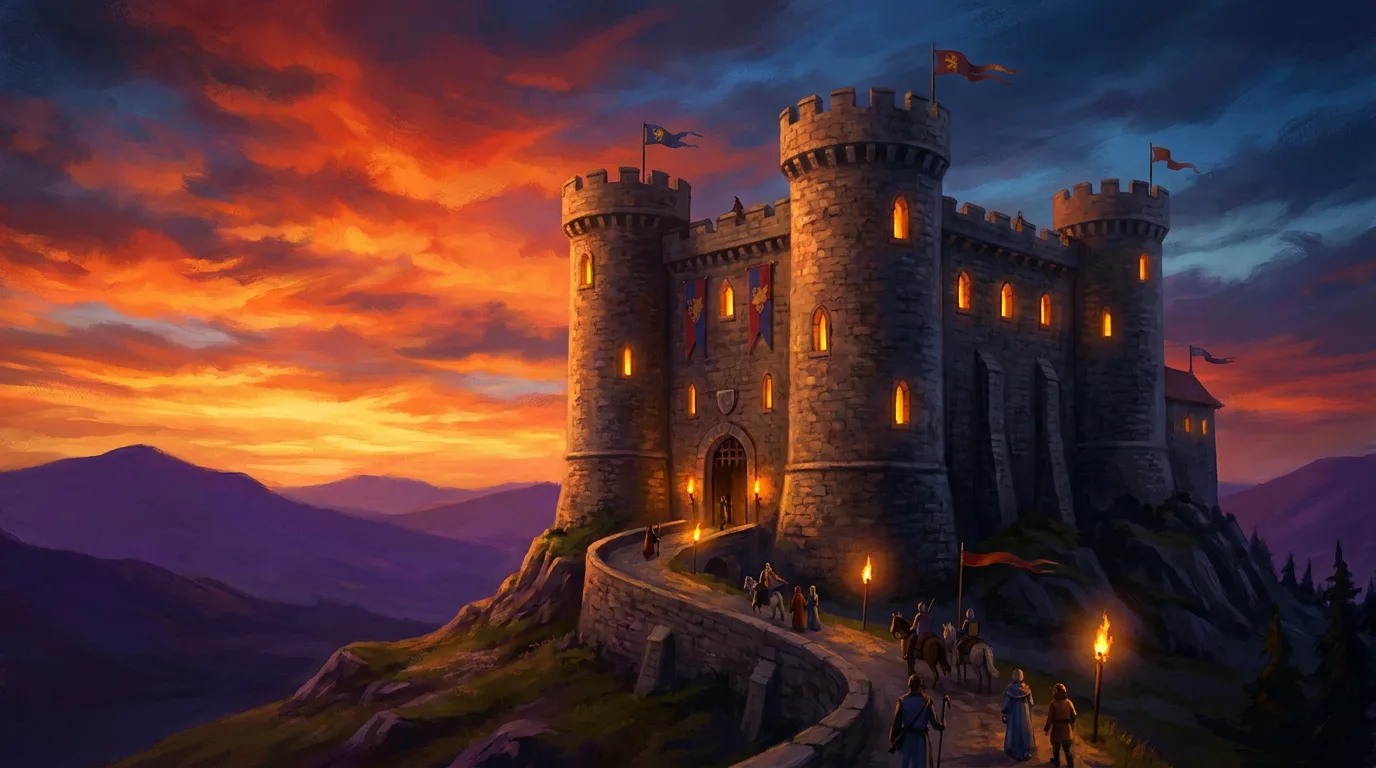
A painted hilltop stone castle with round towers and heraldic banners against a dramatic dusk sky

Castle Name Generator

Castles, keeps, and fortresses named as if they had held their hill for centuries.

Castle Name Generator

Generate names for fantasy castles, keeps, fortresses, citadels, strongholds, and holds across six terrains, each with an optional defensive reputation - free and instant, right in your browser.

How castles and fortresses get their names

A castle name is a small label doing large work. It has to fix a fortress to a specific hill, headland, or ford, tell the reader what kind of stronghold they are looking at, and sound as though soldiers have shouted it across a wall for generations. This generator builds castle names the way real ones were built: a setting sets the terrain the walls rise from, a structure sets the exact fortification word, and each result can carry an optional defensive reputation, the one line that tells you what the place has survived.

Place, house, or feature

Nearly every real castle name comes from one of three sources, and fantasy fortifications are most believable when they do too. Place-names tie the fortress to the land it holds: a keep called Dunmarrow sits on the crag of that name, and the crag will still be there long after the family that built the walls is forgotten, which is why so many real castles carry the name of their hill or their river-crossing. House-names commemorate the lord or line that raised the stronghold, and they invite an obvious question the moment the line dies out or the castle changes hands. Descriptive names, the Iron Keep or the Grey Citadel, record what a traveler saw from the road: the color of the stone, the height of the towers, the mood of the place. The most convincing maps mix all three, because real fortifications were named at different times, by different people, for different reasons.

The fortification words worldbuilders get wrong

Castle, keep, fortress, citadel, stronghold, and hold are not interchangeable words for "big stone building", and readers who know the difference notice. A castle is the whole fortified seat of a lord, walls and towers and hall together. A keep is the single strongest tower inside it, the last redoubt when everything else has fallen. A fortress is built for war rather than for living, a garrison rather than a household, which is why calling a cozy ancestral home a fortress rings slightly false. A citadel is the fortified heart of a city, the stronghold its people fall back into when the outer walls are breached. Stronghold and hold are the loose words, useful precisely when you want the sense of a defensible seat without pinning down its exact form. The generator's structure selector exists so these words stay honest: choose keep and every result is a keep, never a randomly promoted citadel.

Consistency across a map

The fastest way to break a reader's trust is a map where every fortress sounds like it was named by a different hand on a different day. Keep three things consistent. First, match the fortification to its terrain: a coastal citadel guards a harbor, a highland keep watches a pass, a border hold garrisons a march, and generating within one setting keeps a region's strongholds sounding related. Second, let the structure word track the military reality: one true fortress on a frontier is worth more than a map where every hamlet claims a citadel. Third, use the epithet sparingly, so that the castle which has never been taken actually stands out. When you need the realm those walls defend, our sibling kingdom name generator works at the map-label scale; this site deliberately owns the single fortification. Everything generated here is free to use in personal and commercial projects alike.

Worked examples

Frequently asked questions

How do I come up with a good fantasy castle name?
Real castles are named three ways, and fantasy fortifications ring true when they follow suit: after the place they stand on (a crag, a ford, a headland), after the house or lord that raised them, or after a descriptive feature everyone could see from a distance. This generator builds names along all three lines. Pick a setting for the terrain flavor and a structure for the exact fortification word, then generate until something sounds like it has held a hilltop for three hundred years. Castle Dunmarrow implies a place; the Bleak Citadel implies a reputation; both are instantly believable on a map.
What is the difference between a castle, a keep, a fortress, and a citadel?
They describe different things. A castle is the whole fortified residence of a lord: walls, towers, gatehouse, and the buildings inside. A keep (also called a donjon) is the single strongest tower at the heart of a castle, the last place to fall in a siege. A fortress is a fortification built for war rather than residence, often a garrison with no noble household at all. A citadel is the fortified core of a city, the stronghold the townsfolk retreat into when the outer walls are breached. A stronghold or a hold is a looser word for any defensible seat, useful when you want the sense of a fortification without committing to its exact form. The structure selector stamps the matching word onto every name so your map's military vocabulary stays consistent.
Should I name a castle after its place, its lord, or a feature?
Any of the three works, and the choice quietly tells a story. Place-names (Castle Dunmarrow, the Fortress of Tidevane) are the most durable, because the crag or the harbor outlives every family that ever held the walls. Descriptive names (the Iron Keep, the Grey Citadel) suggest something a traveler could see from the road: the color of the stone, the shape of the towers, the mood of the place. A castle named for a defensive reputation, the Unbreached or one that has never opened its gates to an enemy, carries its whole history in a single line. Mix all three across one map and it reads like a country that was fortified over centuries, not in an afternoon.
Can I use these names in my novel, game, or D&D campaign?
Yes, that is exactly what the tool is for. The names suit fantasy novels, tabletop campaigns, video game worlds, interactive fiction, and worldbuilding wikis. Generate a batch, keep what fits, and feel free to recombine parts: take the root from one result and the structure word from another, or promote a generated keep into a full castle as your setting's history demands. The optional epithet gives a game master an instant hook: why has this hold never been taken, and what happens when the party is the first to try?
Can I use a generated name commercially, in something I sell?
Yes. Names themselves are not copyrightable and we claim no rights over the generator's output, so you can use the results in commercial novels, games, brands, and products. Every root in the corpus is original invention; the tool contains no real castle names such as Windsor or Bodiam and no fortifications from existing franchises. For a commercial project it is still worth running a quick search to confirm the exact name is not already a registered trademark in your market.
Is the generator free, and do you store what I generate?
It is completely free: no account, no daily limit, no premium tier. The generator runs entirely in your browser, so your selections and the names it produces never leave your device and nothing is stored on a server. Once the page has loaded it even keeps working if your connection drops.
How is this different from the kingdom name generator?
They work at different scales of the same map. This castle generator names a single fortification: the specific keep, fortress, or citadel that sits on a hill or guards a pass. The kingdom generator at kingdom.namesplease.app names the whole realm those fortifications defend. Name the kingdom first, then garrison its borders with castles from here, and use the mountain and forest generators for the terrain in between.

Guides